
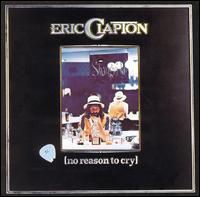
 Hall of Fame, Eric Clapton said that after he heard their debut album, Music from Big Pink, he wanted to join the group, the fact that they already had a guitarist in Robbie Robertson notwithstanding. In the winter of 1975-1976, when he cut No Reason to Cry at the Band's Shangri-la Studio in Malibu, California, he came as close as he ever would to realizing that desire. Clapton is a musical chameleon; though some of No Reason to Cry is identifiable as the kind of pop/rock Clapton had been making since the start of his solo career (the best of it being "Hello Old Friend," which became his first Top 40 single in two years), the most memorable music on the album occurs when Clapton is collaborating with members of the Band and other guests. He duets with Band bassist Rick Danko on Danko's "All Our Past Times," and with Bob Dylan on Dylan's "Sign Language," as Robertson's distinctive lead guitar is heard rather than Clapton's. As a result, the album is a good purchase for fans of Bob Dylan and the Band, but not necessarily for those of Eric Clapton. [The CD reissue adds a bonus track, "Last Night," which is a traditional 12-bar blues song credited to Clapton.]
Tuesday, October 04, 2005
Eric Clapton - No Reason to Cry
When he gave a speech inducting the Band into the Rock & Roll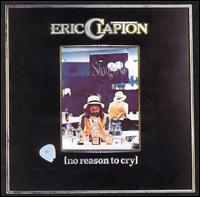 Hall of Fame, Eric Clapton said that after he heard their debut album, Music from Big Pink, he wanted to join the group, the fact that they already had a guitarist in Robbie Robertson notwithstanding. In the winter of 1975-1976, when he cut No Reason to Cry at the Band's Shangri-la Studio in Malibu, California, he came as close as he ever would to realizing that desire. Clapton is a musical chameleon; though some of No Reason to Cry is identifiable as the kind of pop/rock Clapton had been making since the start of his solo career (the best of it being "Hello Old Friend," which became his first Top 40 single in two years), the most memorable music on the album occurs when Clapton is collaborating with members of the Band and other guests. He duets with Band bassist Rick Danko on Danko's "All Our Past Times," and with Bob Dylan on Dylan's "Sign Language," as Robertson's distinctive lead guitar is heard rather than Clapton's. As a result, the album is a good purchase for fans of Bob Dylan and the Band, but not necessarily for those of Eric Clapton. [The CD reissue adds a bonus track, "Last Night," which is a traditional 12-bar blues song credited to Clapton.]
Hall of Fame, Eric Clapton said that after he heard their debut album, Music from Big Pink, he wanted to join the group, the fact that they already had a guitarist in Robbie Robertson notwithstanding. In the winter of 1975-1976, when he cut No Reason to Cry at the Band's Shangri-la Studio in Malibu, California, he came as close as he ever would to realizing that desire. Clapton is a musical chameleon; though some of No Reason to Cry is identifiable as the kind of pop/rock Clapton had been making since the start of his solo career (the best of it being "Hello Old Friend," which became his first Top 40 single in two years), the most memorable music on the album occurs when Clapton is collaborating with members of the Band and other guests. He duets with Band bassist Rick Danko on Danko's "All Our Past Times," and with Bob Dylan on Dylan's "Sign Language," as Robertson's distinctive lead guitar is heard rather than Clapton's. As a result, the album is a good purchase for fans of Bob Dylan and the Band, but not necessarily for those of Eric Clapton. [The CD reissue adds a bonus track, "Last Night," which is a traditional 12-bar blues song credited to Clapton.]
Subscribe to:
Post Comments (Atom)
Popular Posts of the Week
-
 We no need to have any certain explanation for indie music. Indie music is love and exploring. Hold on now, Youngster... Dancing, jumping, t...
 -
 Exclusive two disc (DVD/CD) U.S. edition includes a bonus 10 track live album recorded in Austin, Texas (exclusive to this release). At The ...
 -
I’ve known about the band Fanfarlo for maybe a month. I’d listened to only a few of their songs, but what I heard was so good I made a ment...
-
 Japandroids (aka JPNDRDS) is a two piece band from Vancouver, BC. I've discovered this band with a weird name Japandroids recently. And ...
 -
 mp3: Morrissey - I'm Throwing My Arms Around Paris mp3: Morrissey - First Of The Gang To Die mp3: Morrissey - How Soon Is Now?
 -
 1. Patrick Wolf - Hard Times "For me this video is my homage to two of my biggest heroes, Elvis Presley and Klaus Nomi." says Pat...
 -
Perhaps I'm feeling melancholy of late, or perhaps this is simply a beautiful song. Either way it's like a long sigh after a hard da...


 Posts
Posts


0 COMMENTS:
Post a Comment