
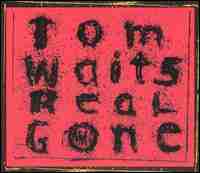
 eliminating one of the cornerstone elements of his sound -- keyboards -- he has also removed his safety net. With songwriting and production partner Kathleen Brennan, he strips away almost everything conventional from these songs, taking them down to the essences of skeletal rhythms, blasted and guttural blues, razor-cut rural folk music, and the rusty-edge poetry and craft of songwriting itself. His cast includes guitarists Marc Ribot and Harry Cody, bassist/guitarist Larry Taylor, bassist Les Claypool, and percussionists Brain and Casey Waits (Tom's son), the latter of whom also doubles on turntables. This does present problems, such as on the confrontational opener, "Top of the Hill." Waits uses his growling, grunting vocal atop Ribot's monotonously funky single-line riff and Casey's turntables to become a human beatbox offering ridiculously nonsensical lyrics. It's a throwaway, and the album would have been better had it been left off entirely. But it's also a canard, a sleight-of-hand strategy he's employed before. The jewels shine from the mud immediately after. The mutated swamp tango of "Hoist That Rag" has stuttered clangs and quakes for drums, decorated by distorted Latin power chords and riffs from Ribot, along with thundering deep bass from Claypool. On the ten-plus minute "Sins of My Father," Cody's spooky banjo walks with Taylor's low-strung bass and Waits' shimmering reverbed guitar as he ominously croons, revealing a rigged game of "star-spangled glitter" where "justice wears suspenders and a powdered wig." It's part revelation, part East of Eden, and part backroom political culture framed by the eve of the apocalypse. It's hunted, hypnotic, and spooky.
Friday, March 24, 2006
Tom Waits - Real Gone
On Real Gone, Tom Waits walks a fraying tightrope. By utterly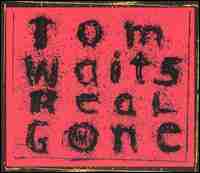 eliminating one of the cornerstone elements of his sound -- keyboards -- he has also removed his safety net. With songwriting and production partner Kathleen Brennan, he strips away almost everything conventional from these songs, taking them down to the essences of skeletal rhythms, blasted and guttural blues, razor-cut rural folk music, and the rusty-edge poetry and craft of songwriting itself. His cast includes guitarists Marc Ribot and Harry Cody, bassist/guitarist Larry Taylor, bassist Les Claypool, and percussionists Brain and Casey Waits (Tom's son), the latter of whom also doubles on turntables. This does present problems, such as on the confrontational opener, "Top of the Hill." Waits uses his growling, grunting vocal atop Ribot's monotonously funky single-line riff and Casey's turntables to become a human beatbox offering ridiculously nonsensical lyrics. It's a throwaway, and the album would have been better had it been left off entirely. But it's also a canard, a sleight-of-hand strategy he's employed before. The jewels shine from the mud immediately after. The mutated swamp tango of "Hoist That Rag" has stuttered clangs and quakes for drums, decorated by distorted Latin power chords and riffs from Ribot, along with thundering deep bass from Claypool. On the ten-plus minute "Sins of My Father," Cody's spooky banjo walks with Taylor's low-strung bass and Waits' shimmering reverbed guitar as he ominously croons, revealing a rigged game of "star-spangled glitter" where "justice wears suspenders and a powdered wig." It's part revelation, part East of Eden, and part backroom political culture framed by the eve of the apocalypse. It's hunted, hypnotic, and spooky.
eliminating one of the cornerstone elements of his sound -- keyboards -- he has also removed his safety net. With songwriting and production partner Kathleen Brennan, he strips away almost everything conventional from these songs, taking them down to the essences of skeletal rhythms, blasted and guttural blues, razor-cut rural folk music, and the rusty-edge poetry and craft of songwriting itself. His cast includes guitarists Marc Ribot and Harry Cody, bassist/guitarist Larry Taylor, bassist Les Claypool, and percussionists Brain and Casey Waits (Tom's son), the latter of whom also doubles on turntables. This does present problems, such as on the confrontational opener, "Top of the Hill." Waits uses his growling, grunting vocal atop Ribot's monotonously funky single-line riff and Casey's turntables to become a human beatbox offering ridiculously nonsensical lyrics. It's a throwaway, and the album would have been better had it been left off entirely. But it's also a canard, a sleight-of-hand strategy he's employed before. The jewels shine from the mud immediately after. The mutated swamp tango of "Hoist That Rag" has stuttered clangs and quakes for drums, decorated by distorted Latin power chords and riffs from Ribot, along with thundering deep bass from Claypool. On the ten-plus minute "Sins of My Father," Cody's spooky banjo walks with Taylor's low-strung bass and Waits' shimmering reverbed guitar as he ominously croons, revealing a rigged game of "star-spangled glitter" where "justice wears suspenders and a powdered wig." It's part revelation, part East of Eden, and part backroom political culture framed by the eve of the apocalypse. It's hunted, hypnotic, and spooky.
Subscribe to:
Post Comments (Atom)
Popular Posts of the Week
-
Revealing a sharp songwriting instinct and unfolding a distinct indie rock influence, the Secret Machines unveil singular scenarios and ref...
-
 Title song will be the first single of next The Rifle record. I loved The Great Escape, however i haven't listened new album but The Gre...
 -
You don't really see that I share a lot of 80s on this blog. I am always so confused by the era, not really implying it's pretenti...
-
Spelling the end of Happy Mondays laddishness, Suede were a southern Smiths transported back to the era of Ziggy Stardust. Their songs we...
-
Dummy , released in 1994, was the debut album of the Bristol-based group Portishead. Building on the promise of their earlier EP, "Nu...
-
 The Hungry Saw Rating:10/10 Once you discover Tindersticks, you will play their music for a long time. Romanticism is the greatest gift God ...
 -
 "Gloomy Sunday" (from Hungarian "Szomoru Vasarnap", is a song written by the Hungarian self-taught pianist and composer ...


 Posts
Posts



0 COMMENTS:
Post a Comment