
 1974 that lasted until the spring of the following year when the band reconvened at guitarist/vocalist Bob Weir's Ace Studios to record Blues for Allah. The disc was likewise the third to be issued on their own Grateful Dead Records label. When the LP hit shelves in September of 1975, the Dead were still not back on the road -- although they had played a few gigs throughout San Francisco. Obviously, the time off had done the band worlds of good, as Blues for Allah -- more than any past or future studio album -- captures the Dead at their most natural and inspired. The opening combo of "Help on the Way," "Slipknot!," and "Franklin's Tower" is a multifaceted suite, owing as much to Miles Davis circa the E.S.P. album as to anything the Grateful Dead had been associated with. "Slipknot!" contains chord changes, progressions, and time signatures which become musical riddles for the band to solve -- which they do in the form of "Franklin's Tower." Another highly evolved piece is the rarely performed "King Solomon's Marbles," an instrumental that spotlights, among other things, Keith Godchaux's tastefully unrestrained Fender Rhodes finger work displaying more than just a tinge of Herbie Hancock inspiration. These more aggressive works contrast the delicate musical and lyrical haiku on "Crazy Fingers" containing some of lyricist Robert Hunter's finest and most beautifully arranged verbal images for the band. Weir's guitar solo in "Sage & Spirit" is based on one of his warm-up fingering exercises. Without a doubt, this is one of Weir's finest moments. The light acoustic melody is tinged with an equally beautiful arrangement. While there is definite merit in Blues for Allah's title suite, the subdued chant-like vocals and meandering melody seems incongruous when compared to the remainder of this thoroughly solid effort.
Sunday, April 09, 2006
Grateful Dead - Blues for Allah
The Grateful Dead went into a state of latent activity in the fall of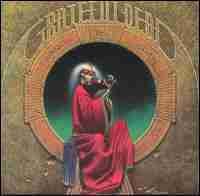 1974 that lasted until the spring of the following year when the band reconvened at guitarist/vocalist Bob Weir's Ace Studios to record Blues for Allah. The disc was likewise the third to be issued on their own Grateful Dead Records label. When the LP hit shelves in September of 1975, the Dead were still not back on the road -- although they had played a few gigs throughout San Francisco. Obviously, the time off had done the band worlds of good, as Blues for Allah -- more than any past or future studio album -- captures the Dead at their most natural and inspired. The opening combo of "Help on the Way," "Slipknot!," and "Franklin's Tower" is a multifaceted suite, owing as much to Miles Davis circa the E.S.P. album as to anything the Grateful Dead had been associated with. "Slipknot!" contains chord changes, progressions, and time signatures which become musical riddles for the band to solve -- which they do in the form of "Franklin's Tower." Another highly evolved piece is the rarely performed "King Solomon's Marbles," an instrumental that spotlights, among other things, Keith Godchaux's tastefully unrestrained Fender Rhodes finger work displaying more than just a tinge of Herbie Hancock inspiration. These more aggressive works contrast the delicate musical and lyrical haiku on "Crazy Fingers" containing some of lyricist Robert Hunter's finest and most beautifully arranged verbal images for the band. Weir's guitar solo in "Sage & Spirit" is based on one of his warm-up fingering exercises. Without a doubt, this is one of Weir's finest moments. The light acoustic melody is tinged with an equally beautiful arrangement. While there is definite merit in Blues for Allah's title suite, the subdued chant-like vocals and meandering melody seems incongruous when compared to the remainder of this thoroughly solid effort.
1974 that lasted until the spring of the following year when the band reconvened at guitarist/vocalist Bob Weir's Ace Studios to record Blues for Allah. The disc was likewise the third to be issued on their own Grateful Dead Records label. When the LP hit shelves in September of 1975, the Dead were still not back on the road -- although they had played a few gigs throughout San Francisco. Obviously, the time off had done the band worlds of good, as Blues for Allah -- more than any past or future studio album -- captures the Dead at their most natural and inspired. The opening combo of "Help on the Way," "Slipknot!," and "Franklin's Tower" is a multifaceted suite, owing as much to Miles Davis circa the E.S.P. album as to anything the Grateful Dead had been associated with. "Slipknot!" contains chord changes, progressions, and time signatures which become musical riddles for the band to solve -- which they do in the form of "Franklin's Tower." Another highly evolved piece is the rarely performed "King Solomon's Marbles," an instrumental that spotlights, among other things, Keith Godchaux's tastefully unrestrained Fender Rhodes finger work displaying more than just a tinge of Herbie Hancock inspiration. These more aggressive works contrast the delicate musical and lyrical haiku on "Crazy Fingers" containing some of lyricist Robert Hunter's finest and most beautifully arranged verbal images for the band. Weir's guitar solo in "Sage & Spirit" is based on one of his warm-up fingering exercises. Without a doubt, this is one of Weir's finest moments. The light acoustic melody is tinged with an equally beautiful arrangement. While there is definite merit in Blues for Allah's title suite, the subdued chant-like vocals and meandering melody seems incongruous when compared to the remainder of this thoroughly solid effort.
Subscribe to:
Post Comments (Atom)
Popular Posts of the Week
-
History They originally called themselves The Reactionaries , with additional band member and singer Martin Tamburovich. According to Watt, ...
-
My Chemical Romance have killed emo, and any preconceived ideas about them should be considered along with it. Connection between Queen'...
-
 We again get on the time machine and find ourselves in early 80s. Today i did a small post about four german musicians' genious electro...
 -
Inspired by psychedelia, sure. Bit of Jim Morrison in the vocals? Okay, it's there. But for all the references and connections that ca...
-
 Rating: 9.5/10 Modern Music Review Starting with an extra striking uneasy words ' All soldiers, they're all gonna die/And all the li...
 -
My name is Bulut and I was born 1985 in Istanbul, Turkey. I discovered the magic of music when I was ten years old, and i used to have a sma...
-
Part 9 http://www.supashare.com/47438939/ or http://rapidshare.de/files/12219745/JC_CISR.part09.rar.html ignore every message of winrar abou...


 Posts
Posts



0 COMMENTS:
Post a Comment